By Christina Ison April 24, 2026
Every percentage point matters in payments. Many business owners focus on sales volume, average ticket size, and chargebacks, yet overlook one document that directly affects profit every month: the merchant statement. It often arrives packed with technical terms, line-item fees, bundled rates, and vague labels that make real costs hard to see. That confusion is expensive.
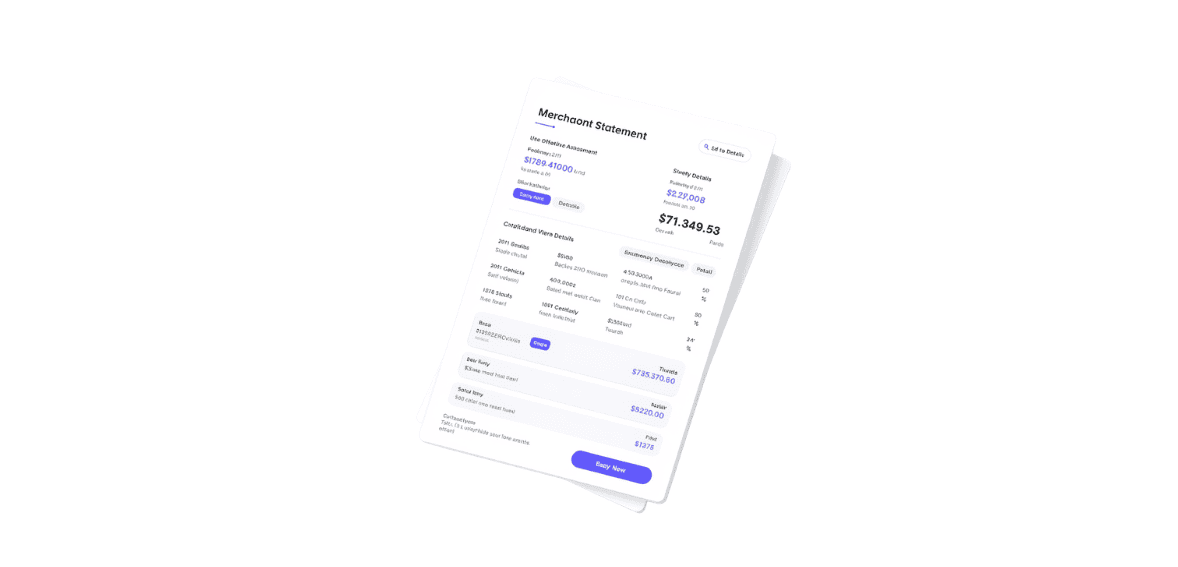
A merchant statement is not just a billing summary. It is a map of how your payment processor, acquiring bank, card networks, and service providers take their share from each transaction. When you know how to read a merchant statement, you can identify hidden credit card processing fees, question padded charges, and negotiate better pricing. That can protect margin without changing your product, marketing, or staffing.
This guide explains how to read a merchant statement in plain English. You will learn where the fees usually appear, how interchange and markup work, which charges deserve closer review, and how to spot merchant account fees that quietly drain profitability over time.
Why Understanding Your Merchant Statement Matters

Understandably, most merchants and companies selling goods and services to customers do so without knowing the costs they incur in selling to those customers. Merchant statements are more than that. They are used to record a wide range of transaction prices. A lack of understanding results in costs blending into the statement.
Small changes in fees can create large losses over time. A small increase in the effective processing rate means several thousand dollars down the drain for a growing business. For this reason, statement analysis becomes a useful profit lever. If your goal is to minimize payment processing costs, the easiest method is to analyze the statement rotting in your inbox.
There is a lot these merchant statements can tell you. Are your processing rates in sync with your pricing contract? Has your processor included service costs in the statement? Are you being charged for non-compliance? Is your sales effective annual rate increasing without any alterations to your sales mix? A detailed analysis of your processor statement can shed light in this blind spot.
What a Merchant Statement Usually Includes
Most merchant statements follow a similar structure, even if the layout changes by provider. You will usually see a summary of total card volume, number of transactions, gross sales, refunds, chargebacks, and total fees. Farther down, the statement often breaks fees into sections such as interchange, assessments, processor markup, monthly account charges, equipment fees, and adjustment items.
You need to know different processing metrics: processing volume, total fees paid, and net deposits. Knowing all three metrics allows you to be the first to see the “true cost” of processing. You’ll need to add a little math to your processing tasks. Start your math here:
Effective Rate = (Total Fees / Total Processing Volume) *

Let’s say you processed $100,000 in volume and paid a total of $3,200 in fees. Your effective rate is 3.2%. To apply the caveat here, the effective rate by itself does not tell the whole story. To avoid that caveat from spinning out of control, if your effective rate changes, more changes occur. The process is that, after you sign the agreement, you do not receive notice of changes.
The Three Core Fee Buckets to Understand
In credit card processing, fees fall within the group of three. To understand the fees your clients require, you need to break your fees down to understand the whole process.
Interchange is the most expensive component of credit card processing as it involves the bank in the card processing system. There are a variety of fees based on credit card usage, transactions, and the type of data and processing.
The first group of fees you see on your client’s processing statement is assessments, which are the fees associated with the card company. These fees are the smallest and, in turn, would negatively affect your clients the least. These would be recorded as a brand access fee in the card processing system.
Processor markup is the fee your pay provider charges on top of the stated terms. This is the most negotiable part of your merchant statement and the most troublesome. Markup can take the form of a fee per transaction, a fee per month, or a percentage of sales. If you want to learn how to audit a merchant statement, start here.
Interchange-Based Pricing vs. Tiered Pricing

The type of price model you choose will determine the transparency of your statement. Interchange-plus pricing provides a segregated statement showing interchange, processing costs, and assessment costs, which in turn helps you understand the provider’s and processing cost margins. This is by far the most auditable pricing model.
With tiered pricing, transactions may fall into qualified, mid-qualified, or non-qualified buckets. Because of this pricing model, the markup is less understandable. In tiered pricing, a processor may shift most transactions into the pricier buckets without clearly stating this, which, depending on the situation, may not be problematic but does provide less transparency.
For merchant statement examination, interchange-plus pricing is not only more understandable, but tiered pricing is not as well. The U.S. Small Business Administration urges reviewing regular spending as a solid recommendation, because managing cash flow is equally important as managing costs. SBA
How to Figure Out the Actual Cost of Your Processing
Don’t base the final rate you receive on what is in the sales proposal. Many businesses receive a final quote that says something like, “2.29% + 10 cents per transaction,” and later find that there are numerous other costs, including multiple monthly fees, PCI fees, network pass-through fees, and other incidental fees, all of which add to the total cost.
To estimate your actual cost, calculate your total monthly fees, then divide this by your total monthly processing volume. Do this for three consecutive months. A single month can be affected by seasonality, refunds/chargebacks, or average ticket size. Processing volume over three months will better establish your processing costs.
If your monthly statement breaks down total volume and fees by charge types, compare charge types. E-commerce and transactions that are keyed or manually entered present a higher risk and, therefore, a higher cost. This cost can be justified and varies by business, but if an in-person business has a higher volume of customers who are expensive and not processed as qualified charges, this should be further analyzed.
The Fees That Quietly Erode Margin
The fees that most negatively impact your margin are often overlooked. While large fees are often most damaging, frequent small fees gradually erode your margin. These include PCI non-compliance fees and recurring account fees. For example, a charge to add a service to an account, a charge to add a regulatory product to an account, a charge when the account is set to an annual setting, and a charge when the account has been maintained. This charge, along with other charges such as a batched account fee and an annual gateway operating fee, is only a portion of the charges. Therefore, only a portion may be justified as needed, but most likely will be redundant or avoidable.
Be on the lookout for duplicate costs across systems. A business using a gateway, processor, point-of-sale platform, and distinct hardware care may be blissfully unaware that they’re paying for overlapping costs for reporting, security, or platform access. Another common problem is “junk fee” designation, where the presumed charge is listed under a name that offers scant context for the service it provides. Recently, the Federal Trade Commission has intensified its examination of deceptive fee actions, and that, in the broader context, is the example that illustrates the importance of straightforward pricing within the financial services industry. FTC.
An effective way to identify concealed merchant fees is to line up this month’s statement with one from a period six or twelve months back. New fees tend to be introduced slowly, if not imperceptibly. A processor might implement a compliance charge or revise a platform fee in a manner that garners less criticism. When your effective rate climbs from a static statement, it is reasonable to conclude that you’ve been impacted by confiscatory or ancillary fees.
Merchant Statement Red Flags to Facilitate Further Repayment Audit
Certain trends and their deviations from the norm should, almost inarguably, elicit inquiry. One example is a sudden, unusual ramp-up of your effective rate. Broad or opaque group accounting for such things as “miscellaneous fees,” “adjustments,” “non-qualified surcharge,” “service package,” etc., should all receive the utmost scrutiny. A statement featuring several pages of listings is not inherently bad, but a lengthy, opaque statement is, almost invariably.
Beware of downgrading calls. If many transactions are dumped into costly pricing tiers, ask why that decision was made. Criteria such as missing data, delayed settlement, and mismatched transactions can lead to costly downgrades. Chronic downgrades can indicate an unfavorable pricing model for merchants.
Also, verify whether authorization fees, chargeback fees, retrieval fees, and monthly minimum fees are covered by the contractual agreements. It is possible for processors to alter terms of the original agreement, especially when contracts allow pricing adjustments. Visa provides support in understanding the workings of the payment ecosystem and the flow of transactions, including network cost placement along the chain.
How to Audit a Merchant Statement Step by Step
Begin by performing some top-level math. Verify each of the following lines in the statement: total sales volume, total fees, total chargebacks, and total credits. Then, determine the effective rate. After that, separate the fees into costs beyond the processors’ control and those within their control.
After that, label each cost. Compare each of them to the terms of your agreement. If you see an unfamiliar cost, address it. Second, look for recurring chargebacks, retrieval fees, and monthly minimum fees. It is much worse to have an unexplained monthly fee than to have unexplained fees resulting from a one-time charge. Finally, review each of the pricing models available to you and choose the one that best meets your needs. If your merchant statement is difficult to analyze, it is a strong sign that the pricing model isn’t working to your advantage.
Review each processor monthly to confirm volume, calculate the effective rate, identify the markup and total monthly fees, and compare with previous statements. Or check for unexplained changes to identify leakage. That simple process reveals more margin leakage than expected.
Payment Processor Statements Can Be Misleading Without Context
A low headline rate does not always mean low total cost. Some processors advertise aggressive pricing but recover margin through monthly platform fees, PCI programs, statement fees, gateway bundles, or expensive downgrades. Others may look more expensive at first glance but deliver better transparency and lower effective cost over time.
This is why businesses should not compare processors based solely on quoted rates. The smarter comparison is statement-to-statement and effective-rate-to-effective-rate. Transparency matters. Contract flexibility matters. Reporting detail matters. A processor that makes costs easy to understand may save money even before any formal renegotiation.
Square
Square is widely known for simple onboarding and flat-rate pricing, especially for smaller merchants and newer businesses. That simplicity can reduce statement confusion because flat-rate models are easier to read than highly layered interchange-plus or tiered statements. The trade-off is that flat-rate pricing may become less cost-efficient at higher volumes or for businesses with lower-risk transaction profiles.
Stripe
Stripe is widely used for online payments and software-driven businesses. Its reporting tools are often more digital and dashboard-based than traditional merchant statements. That can improve usability, but merchants still need to understand dispute fees, international card costs, payout timing, and any add-on billing tied to platform features.
Fiserv
Fiserv participates in merchant processing and provides services through several trading partnerships. In larger or more customized accounts, statements can grow more complex, as up to several pricing service components can be packaged together. As such, meticulous fee mapping becomes crucial.
When to Renegotiate Merchant Processing Fees
You might consider renegotiating if you notice an increased volume, a higher average ticket, a lower chargeback risk, or a higher markup, and it still makes sense to remain at tiered pricing and move to an interchange-plus transparent pricing model.
Before you renegotiate, gather your statements. Look at three of your most recent statements, figure out your average effective rate, list out your monthly fees, and track the fees that you’re not familiar with. A processor will take your renegotiation far more seriously if you offer them specific statements and costs, as opposed to any broad complaints.
If the provider lacks the ability to justify or clarify any of the fees that they charge, that will work in your favor. In payments, when things get complex, you can be sure it’s to protect their margins, not to protect the merchant.
Conclusion
The best way to spot hidden fees in payments is to learn how to read a merchant statement and see past the superficial pricing and markup. Knowing how assessments, interchange, recurring fees, and markup all play into their costs is the best way to capture all the hidden fees.
Do not standardize your merchant statement—think of it as your monthly margin report. For this statement, calculate your effective rate, challenge charges you do not understand, and push for transparency and clear answers. The more time merchants spend on their merchant statements, the more credit card processing fees they control and the greater the margin they take home.
FAQs
What is a merchant statement?
A merchant statement is a monthly statement your payment processor or merchant services provider sends you covering your sales, refunds, chargebacks, and all the fees you were charged for payment processing.
How do I know if my merchant processing fees are too high?
Knowing where you stand in relation to your earning capacities starts with your effective rate (your fees divided by your processing volume). Then you should watch that number for month-to-month changes. If that charge is rising with no good reason, or if your statement is riddled with vague, recurring charges, then you are getting charged too much.
What are hidden merchant fees?
Some hidden merchant fees include any vague, poorly labeled, unexpected, or buried charges that are just part of the standard processing charges. Examples include PCI noncompliance fees, account maintenance fees, statement fees, and unexplained service charges.
Is interchange-plus better than tiered pricing?
In many cases, interchange-plus pricing is the better deal, especially for transparency, as tiered pricing groups funnel excessive markup and costs.